

Haivya Demonstrates Programmable Bioacoustic Control Across Seven Plant Species
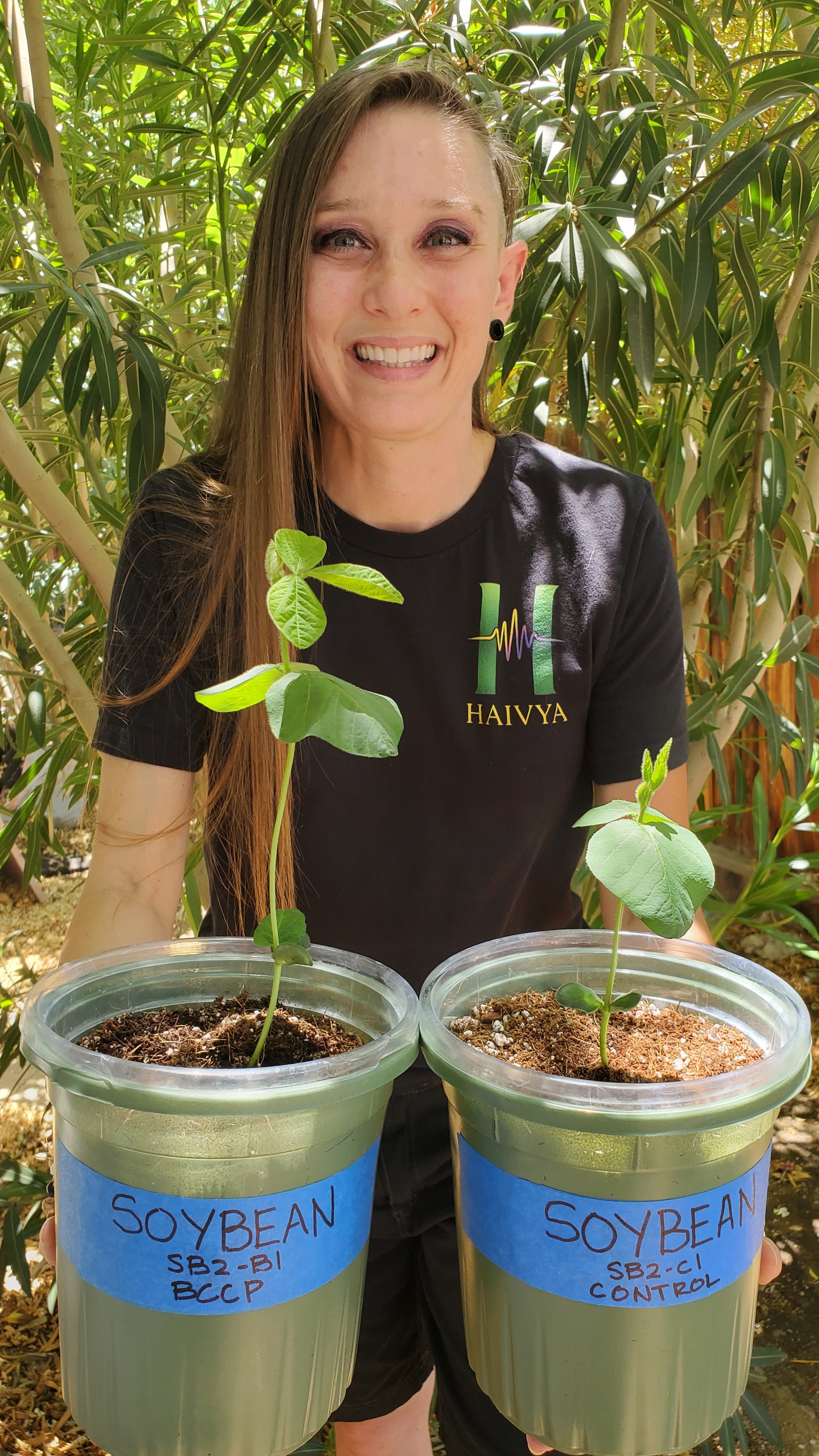
Andrea Ott-Dahl, Founder and Chief Scientist of Haivya, holding BCCP treated and control soybean plants.
Newly findings and two independent trials show gains in rooting, yield, water efficiency and biochemical expressions – some changes occurring within 24 hours.
distinct, measurable plant responses across seven species and four plant families – without added chemicals or gene editing.
Most strikingly, genetically uniform plants exposed to two different BCCP protocols developed predictably different outcomes. One protocol produced 42% greater yield, while another produced 59% greater yield, 21.5% higher potency, a 14.2% faster cycle and reduced water consumption compared to controls - all from the same genetics, under matched conditions.
"This is not a yield hack for a single crop," said Haivya Founder and Chief Scientist Andrea Ott-Dahl. "It is evidence of a programmable biological platform. We are not simply stimulating plants – we are selecting an outcome and designing the protocol towards it.”
What makes BCCP different? Prior acoustic stimulation research has documented isolated plant responses to single stimuli. BCCP takes a different approach: a structured protocol that delivers species-specific bioacoustic signaling, with outcomes shaped by both protocol design and each cultivar’s own biology.
“With larger commercial validation, BCCP has the potential to become one of the most meaningful non-genetic plant optimization platforms since modern biotechnology,” said Keston Ott-Dahl, COO.
Independent validation. In a 100-plant propagation trial run and statistically analyzed by Dr. Allison Justice (Ph.D., Clemson University), BCCP-treated hemp clones showed a 25.6% improvement in rooting scores over untreated controls (F=4.45, p=0.0057) in one cultivar, while a second cultivar showed a directional advantage in lateral branching. In a separate 36-plant independently observed validation trial analyzed by Dr. Robert Flannery (Ph.D., UC Davis), BCCP-treated plants of a high-value specialty crop produced 90% more total sellable biomass and 120.9% more premium biomass than matched controls, using less water per gram of output while maintaining equivalent biochemical potency, all confirmed at p<0.0001.
Gains across every species. Across every species evaluated, BCCP-treated plants developed enhanced root systems and greater lateral branching from the earliest developmental stages – structural advantages that preceded and supported the yield outcomes at harvest ranging from 29% to more than 100% depending on species and protocol configuration. Earlier and more uniform reproductive transition was also documented across multiple species, a finding with direct implications for growers where predictable, synchronized harvest reduce cost and risk. In soybean, one of the world’s most widely grown food commodities, BCCP plants reached reproductive maturity faster and more uniformly than controls, with a 46% greater pod count at the trial’s early benchmark. In basil, BCCP accelerated flowering and produced 45.6% greater biomass over controls and in jalapeño peppers, this translated to a 171% increase in fruit count over untreated controls.
Biochemical pigment pathway activation across multiple species. In those same pepper plants, and across basil, lemon balm, peppermint, spearmint, and a high-value specialty crop, Haivya documented increased anthocyanin expression – an antioxidant pigment compound and marker of biochemical pathway engagement – in BCCP-treated plants, with no comparable expression in untreated controls. In bell pepper, Haivya went further, demonstrating it could switch a single fruit's pigmentation on and off by changing the protocol alone – cycling the fruit between deep purple expression and its typical ripening color, with a full shift occurring in as little as 24 hours. Together, the findings suggest BCCP can engage a shared biological response mechanism across diverse species and direct it.
Haivya has filed a U.S. non-provisional patent with five supporting provisional filings on the BCCP platform and is pursuing collaborative partnerships across food, medicinal, industrial crop, and climate applications.
Full trial data and methodology published on ResearchGate, and a condensed brief is available on the company's website.
HAIVYA, Inc. is a Delaware C Corporation developing BCCP, a proprietary patent-pending platform invented by Founder and Chief Scientist Andrea Ott-Dahl, using structured sound exposure to influence plant development, biological output, and resource efficiency. The company is focused on non-chemical, non-genetic tools for precision agriculture, therapeutic cultivation, and plant-based biomanufacturing.
Keston Ott-Dahl
HAIVYA, Inc
+1 925-566-4353
keston@haivya.com
Keston Ott-Dahl
Haivya, Inc
+1 925-566-4353
keston@haivya.com
Visit us on social media:
LinkedIn
Legal Disclaimer:
EIN Presswire provides this news content "as is" without warranty of any kind. We do not accept any responsibility or liability for the accuracy, content, images, videos, licenses, completeness, legality, or reliability of the information contained in this article. If you have any complaints or copyright issues related to this article, kindly contact the author above.
